Available now
How to Reach Your Teenager
When you can feel the distance growing and don't know what you're doing wrong.
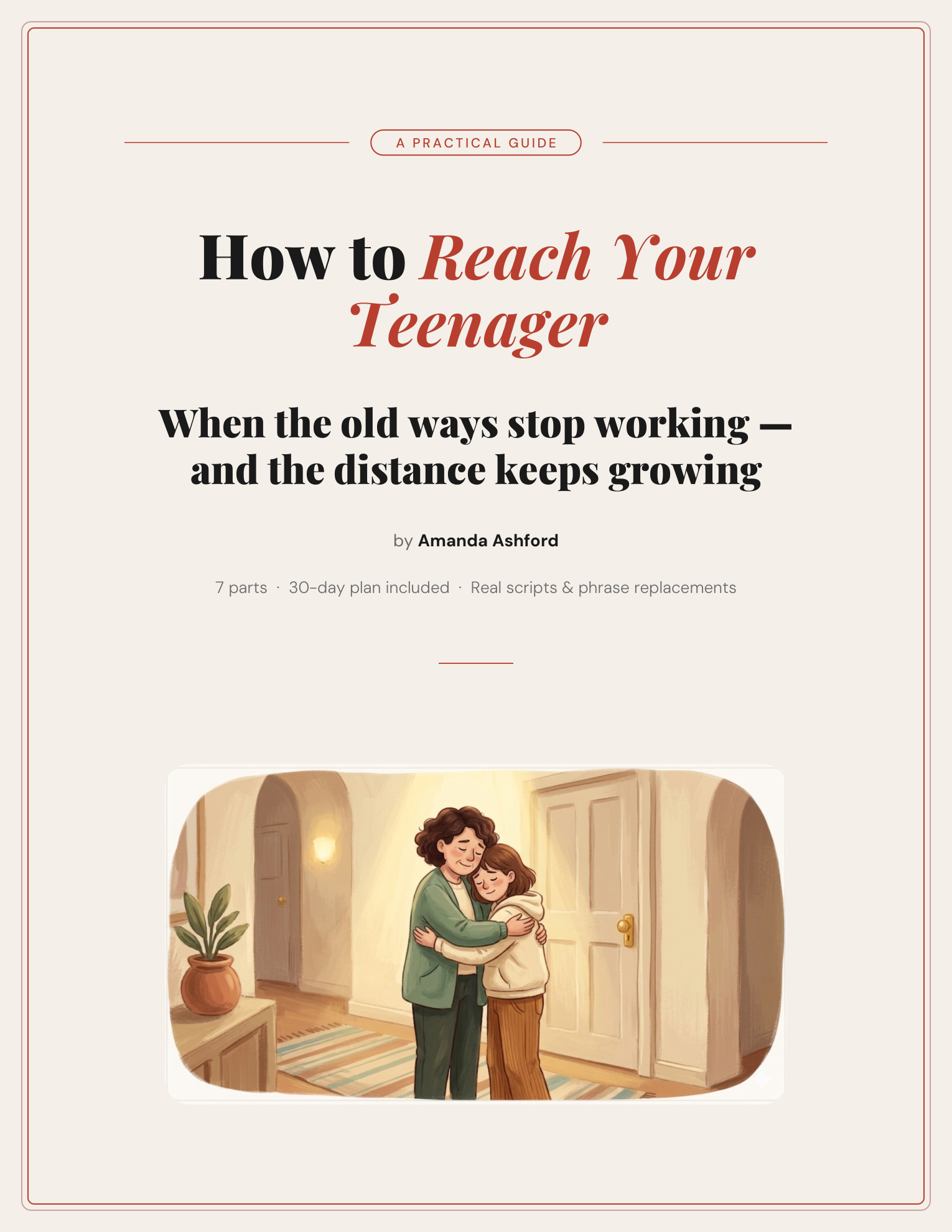
- 55-page PDF — read in one evening, use the next morning
- BONUS: After the Fight — a 3-page recovery protocol for the hours after a blowup
- 12 phrase replacements — the loving-sounding lines that quietly close the door
- A 30-day plan — one conversation at a time, to restart talking
- Crisis recognition — when a shut-down is something more serious
$14.99
$19.99
Save $5
Get the guide →
Peek inside the guide
What's inside
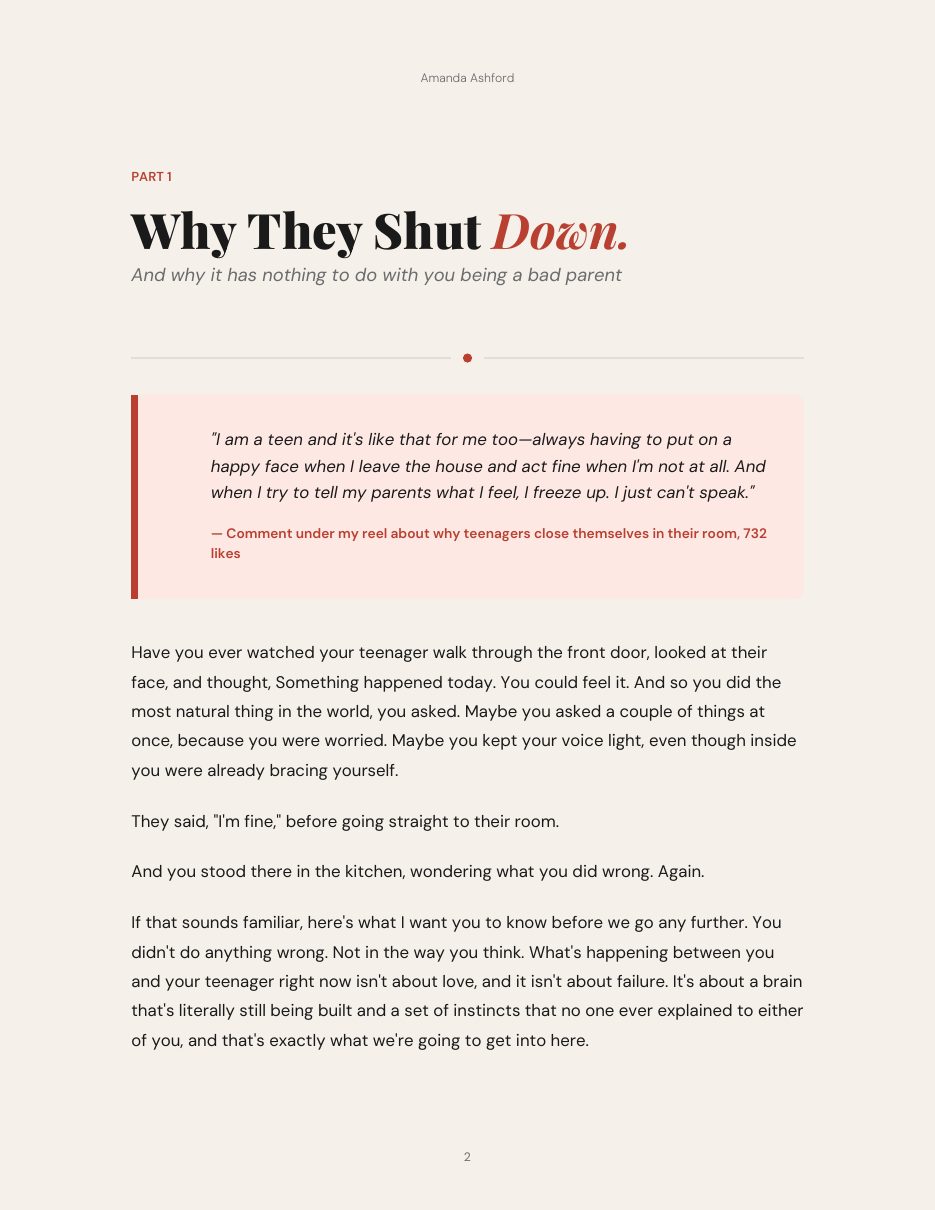
Part 1
Why they shut down
The construction site nobody warned you about. What's happening in their brain at 12–13, and why it has nothing to do with you being a bad parent.
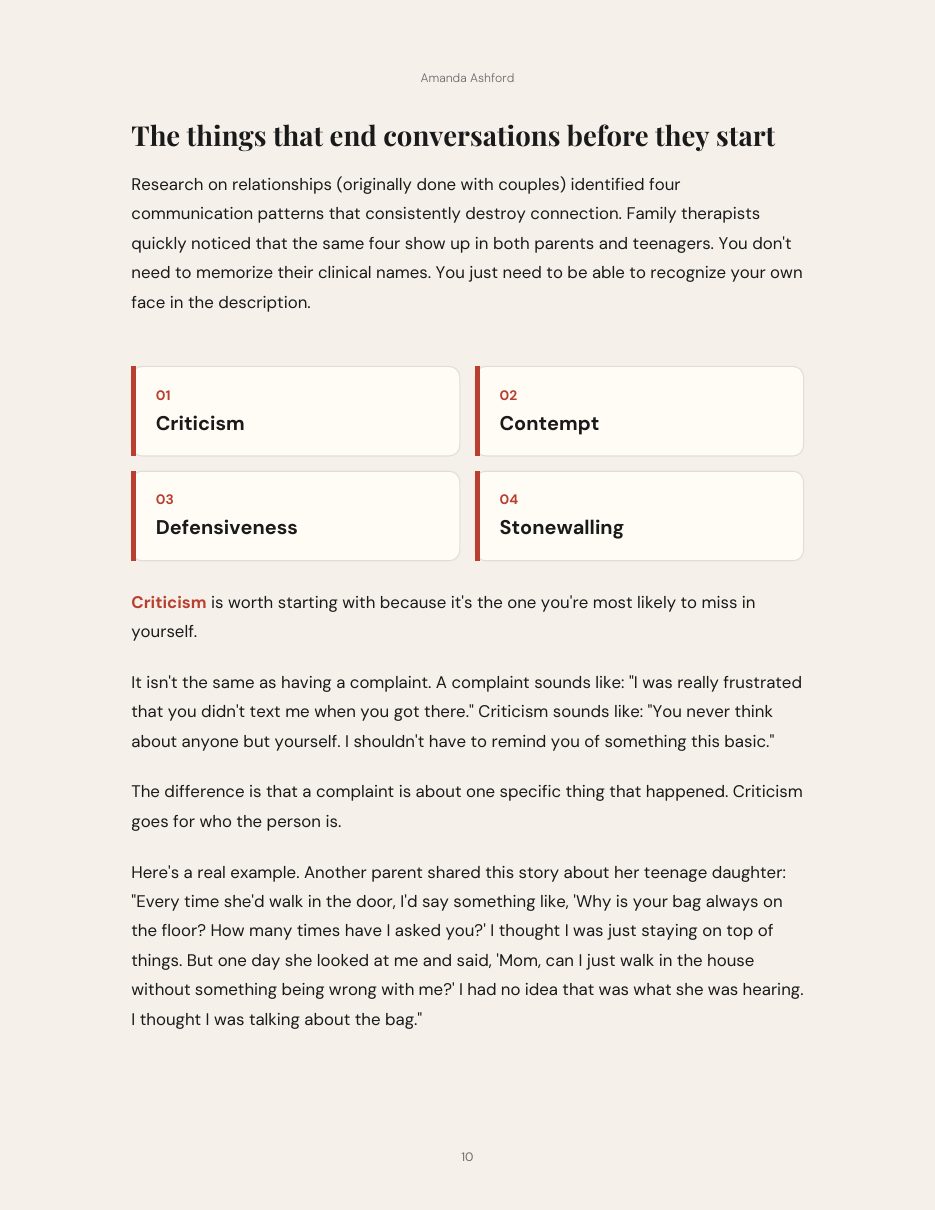
Part 2
What's actually breaking the connection
The four communication patterns that quietly end conversations before they start. You'll recognize at least one.
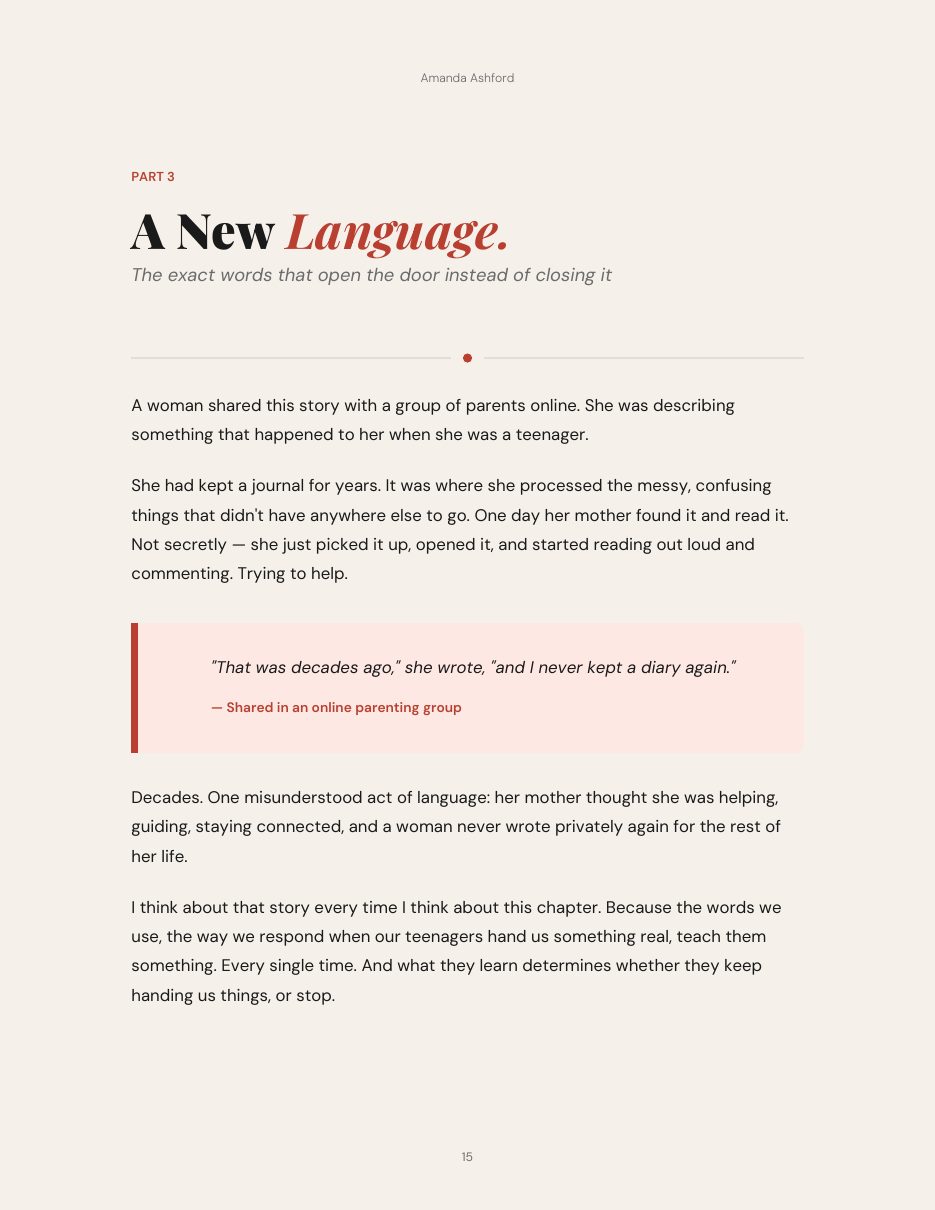
Part 3
A new language
The exact words that open the door instead of closing it. The formula plus 12 phrase replacements.
Part 4
How to listen so they actually start talking
Why advice closes the door. The seven questions that work. The five-minute exercise.
Part 5
Solving problems together
Why "because I said so" hits a wall. The three-step approach plus scripts for four real situations.
Part 6
Show that you're a real person
The three stories you can tell. The one thing that ruins it. The restoration ritual after a fight.
Part 7
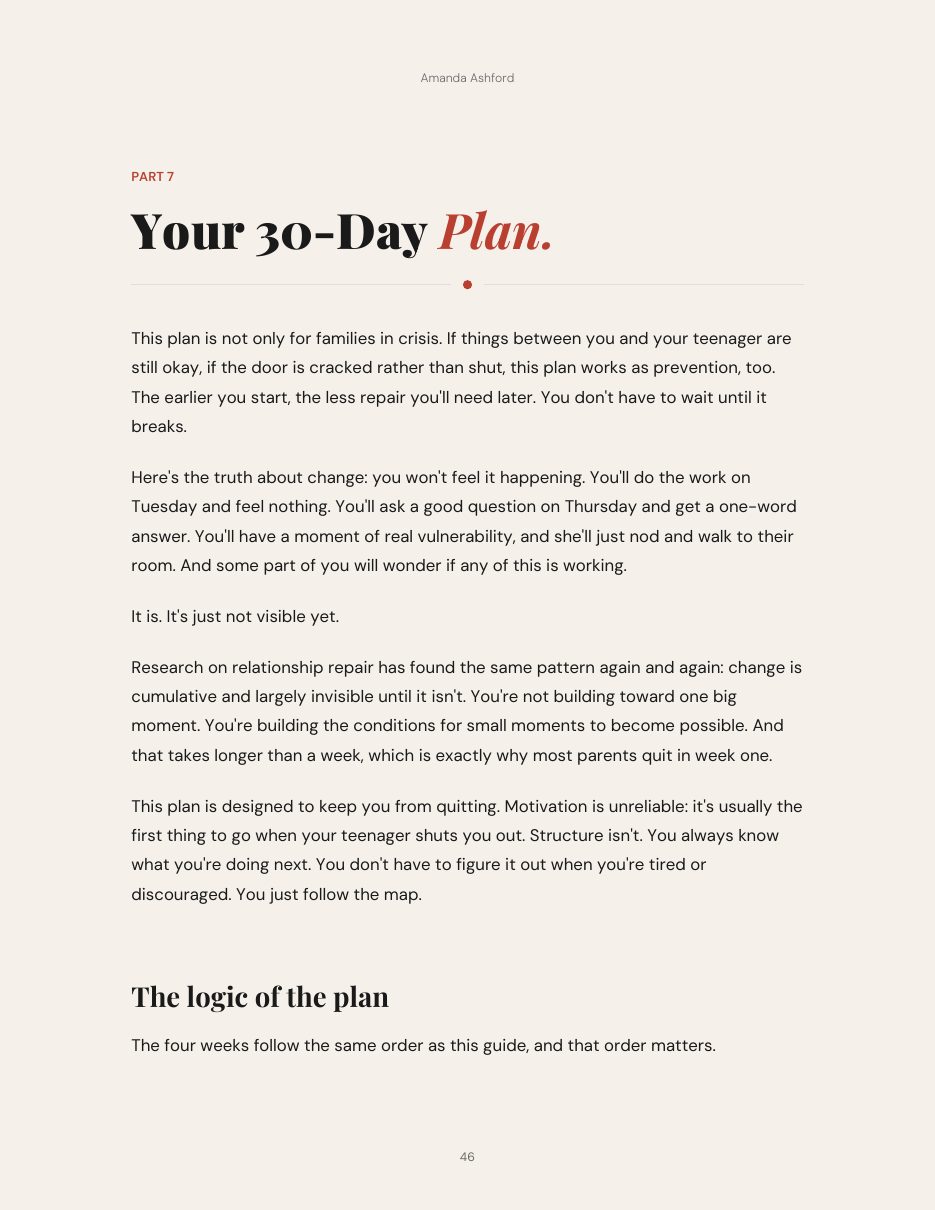
Your 30-day plan
Week by week, one conversation at a time. Days 1–7: stop the destroyers. 8–14: the five-minute practice. 15–21: vulnerability. 22–30: solve one problem together.
Does this sound like your house right now?
- They come home and go straight to their room. No hello. The light under the door is how you know they're okay.
- "I'm fine" is the answer to everything now. School. Friends. Why they were crying. Why they didn't eat.
- Every attempt to connect ends in a fight or in silence. Calm voice, firm voice, saying nothing — nothing lands.
- You don't know what you're doing wrong. You read the books. You try the things. You stay up wondering when you became the parent they don't want to talk to.
You're not imagining it, and you're not the first parent to feel like a stranger to your own teenager. This guide is built for that exact gap — the distance you can feel but can't name.
What's actually possible after this guide
Not a miracle. A different baseline. Slow, real, and durable.
01
You stop accidentally closing the door.
You learn the small phrases that sound caring but quietly shut your teen down. Once you can name them, you stop using them.
02
You have words for the moments that used to leave you frozen.
Real scripts for real situations. Not perfect-parent talk — words you can actually say out loud at 7 p.m. in your own kitchen.
03
Repair conversations start working.
You stop trying to fix the whole relationship in one talk. You learn what a small repair actually sounds like — and you can stop holding your breath after a fight.
04
You stop feeling like you're failing.
Because something is actually changing. Slowly. Real change is invisible at first — the guide shows you exactly what to look for.
Who wrote this

Common questions
Is this for parents of teens of a specific age?
Yes — it's written for parents of teenagers 12 through 17. The strategies map onto the developmental shifts that happen across all of those years.
My teenager barely speaks to me. Isn't it too late?
This guide is written for exactly that point. You don't need your teen to cooperate for it to work — the first shifts are things you change, and the door starts opening from your side first.
My teenager has ADHD / anxiety. Will this still work?
Most of it, yes. The communication frameworks apply across neurodivergent teens too. There's also a section that helps you recognize when a shut-down is something more clinical — and tells you when to bring in a professional instead of relying on a book.
How long is the guide, and how long does it take to read?
55 pages, seven short parts. Most parents finish in one evening. It comes with a separate bonus, After the Fight — a 3-page recovery protocol you can use the very next time things blow up.
What format is it? Can I read it on my phone?
PDF, optimized for both desktop and phone reading. Instant download after purchase.
The next silent dinner doesn't have to be the pattern.
You can read this in one evening. Try one phrase replacement at breakfast tomorrow — and watch what a single changed sentence does.
$14.99
$19.99
Launch price
Get the guide →
Rules turning into a war too?
Once the conversation is open, Say No to Your Teen and Stay Close handles the limits. See that guide →